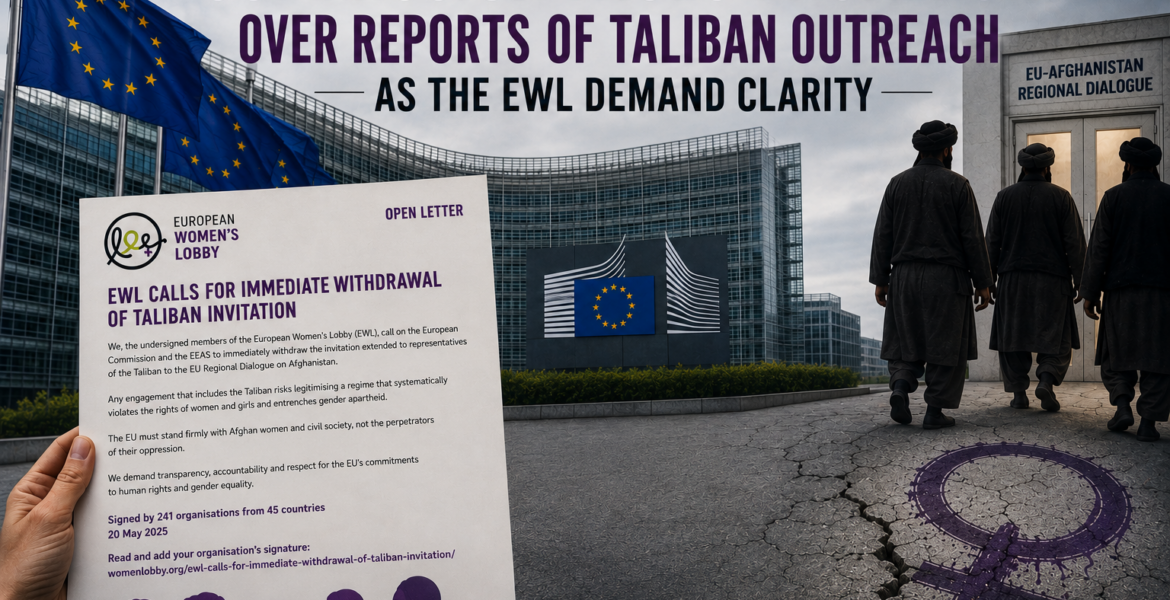
Rumours that the European Commission may have extended an invitation to Taliban representatives have triggered a fierce reaction from women’s rights organisations, though no invitation has been officially confirmed. The European Women’s Lobby, Europe’s largest umbrella organisation for women’s rights, issued a blistering open letter to Commission President Ursula von der Leyen, warning that even the suggestion of hosting the Taliban in Brussels risks undermining the EU’s credibility as a global defender of human rights.
The letter, published on 22 May, stresses that it is responding to a “reported invitation” — a formulation that reflects the current ambiguity. The Commission has not acknowledged any such outreach, and no official agenda entries or public statements indicate that a Taliban delegation is expected in Brussels. Yet the mere circulation of the claim has been enough to ignite political alarm, particularly among organisations that have long documented the Taliban’s systematic erasure of women and girls from public life.
The EWL’s intervention is uncompromising. It recalls that the European Court of Justice has already recognised the Taliban’s treatment of women and girls as persecution, citing the regime’s sweeping prohibitions on education, employment, healthcare, travel, and even the ability to leave one’s home without a male escort. “In other words,” the letter states, “from enjoying their fundamental human rights.” For the EWL, this is not simply a matter of diplomatic protocol but a question of principle: any engagement that appears to normalise or legitimise such a regime would contradict the EU’s own commitments to equality and human dignity.
The organisation frames the Taliban’s governance as a form of gender apartheid — a deliberate system of segregation and subjugation based solely on sex. Against this backdrop, the idea of welcoming Taliban representatives to the political capital of the European Union, even hypothetically, is presented as a profound moral and political misstep. The EWL argues that Brussels cannot claim to champion a “Union of Equality” while entertaining contact that risks signalling tolerance for the systematic oppression of half a population.
What makes the controversy particularly sensitive is the EU’s existing pattern of engagement with the Taliban. Since 2021, EU officials have held technical‑level talks with Taliban representatives in Doha, framed strictly around humanitarian access and operational issues. But hosting such a delegation in Brussels would represent a significant shift — one that many fear could be interpreted as a step toward political recognition. The EWL’s letter appears designed to pre‑empt precisely that scenario, urging the Commission to rule out any such move and to reaffirm that future engagement must be conditional on the full restoration of women’s and girls’ rights.
The letter’s tone reflects a broader anxiety about Europe’s moral posture at a time when authoritarian regimes are testing the boundaries of international norms. “At this critical moment,” it warns, “the European Union must demonstrate leadership and integrity by refusing to engage with a regime that enforces systemic gender oppression.” The rights of women and girls, it insists, are non‑negotiable.
Whether the Commission will publicly clarify the situation remains to be seen. But the political message from Europe’s women’s rights community is unmistakable: even the perception of outreach to the Taliban is enough to raise serious questions about the EU’s values, its global leadership, and its willingness to stand with Afghan women and girls at a time when their freedoms have been all but extinguished.