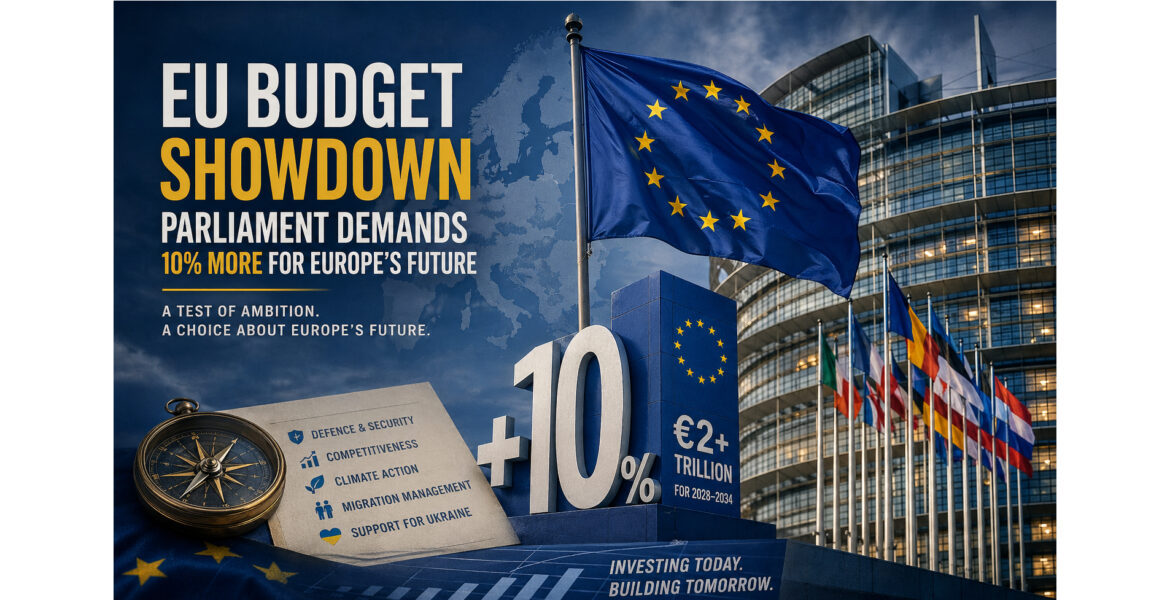
The European Parliament’s vote on Tuesday to demand a seven‑year EU budget 10 percent higher than the European Commission’s proposal is more than a routine skirmish in the annual Brussels budget ritual. It is a statement of political intent, a test of institutional confidence, and a reminder that the Parliament—often underestimated in budgetary debates—still knows how to flex its muscles when the stakes are high. As someone who spent years on the Budgets Committee and served as First Vice‑Chair of the Budgetary Control Committee, I recognise the significance of this moment. A budget of more than €2 trillion is not just a line on a spreadsheet. It is a declaration about the kind of Union we want to build.
The Parliament’s message is clear: the EU cannot meet its ambitions with a shrinking wallet. Whether it is defence cooperation, industrial competitiveness, climate transition, migration management or support for Ukraine, the demands on the EU budget have grown dramatically since the last Multiannual Financial Framework was agreed. The world has changed faster than the EU’s financial architecture, and MEPs are right to insist that the next MFF must reflect reality rather than nostalgia for a simpler time.
But ambition comes with controversy. A 10 percent increase over the Commission’s proposal will inevitably provoke resistance from several national capitals. The so‑called “frugal” governments—who already balked at the Commission’s more modest figures—will argue that taxpayers cannot be expected to shoulder additional burdens at a time of inflation, high interest rates and domestic budget tightening. They will warn of political backlash, of populists waiting to weaponise any hint of “Brussels overspending”. These arguments are predictable, but they cannot be dismissed.
Still, the alternative—pretending the EU can do more with less—is simply dishonest. Over the past decade, the Union has repeatedly been asked to respond to crises that no Member State can manage alone. The pandemic, the energy shock, Russia’s war against Ukraine, and the accelerating climate emergency have exposed the limits of national budgets and the necessity of collective investment. The Parliament’s vote reflects this accumulated experience. It is not about extravagance; it is about credibility.
There is also a deeper institutional question at play. The Parliament has long argued that the EU budget is structurally underpowered, constrained by outdated revenue sources and political compromises that prioritise national rebates over European priorities. By pushing for a higher ceiling, MEPs are challenging the Commission and the Council to rethink the fundamentals. If Europe wants strategic autonomy, then it must be willing to fund it. If it wants to lead on climate, then it must invest at scale. If it wants to support Ukraine for as long as necessary, then it must ensure predictable, long‑term financing. These are not ideological positions; they are practical necessities.
Of course, raising the budget is only half the story. The other half is ensuring that every euro is spent effectively, transparently and in line with EU values. As someone who spent years scrutinising EU expenditure, public trust depends not only on how much we spend but on how well we spend it. The Parliament’s vote should therefore be accompanied by a renewed commitment to strong oversight, rigorous evaluation and zero tolerance for fraud or misuse.
Critics will say the Parliament is overreaching. They will argue that MEPs are making promises they cannot deliver, that the Council will ultimately dictate the final numbers, and that the Parliament’s vote is symbolic rather than decisive. But symbols matter in European politics. They shape expectations, frame negotiations and signal priorities. By adopting a bold position early, the Parliament has set the tone for the months ahead. It has reminded the other institutions that the EU budget is not merely an accounting exercise but a political choice about Europe’s future.
The coming negotiations will be difficult. They always are. But this time, the gap between ambition and resources is wider than ever, and the consequences of underfunding are more severe. Europe cannot afford another MFF that is outdated the moment it is signed. The Parliament has taken a responsible step by demanding a budget that matches the scale of the challenges ahead. Now it is up to the Member States to decide whether they want an EU that merely survives crises—or one that is equipped to thrive in the years to come.
Derek Vaughan CBE, Former MEP and First Vice Chair of the Budgetary Control Committee, Member of the Budget Committee