
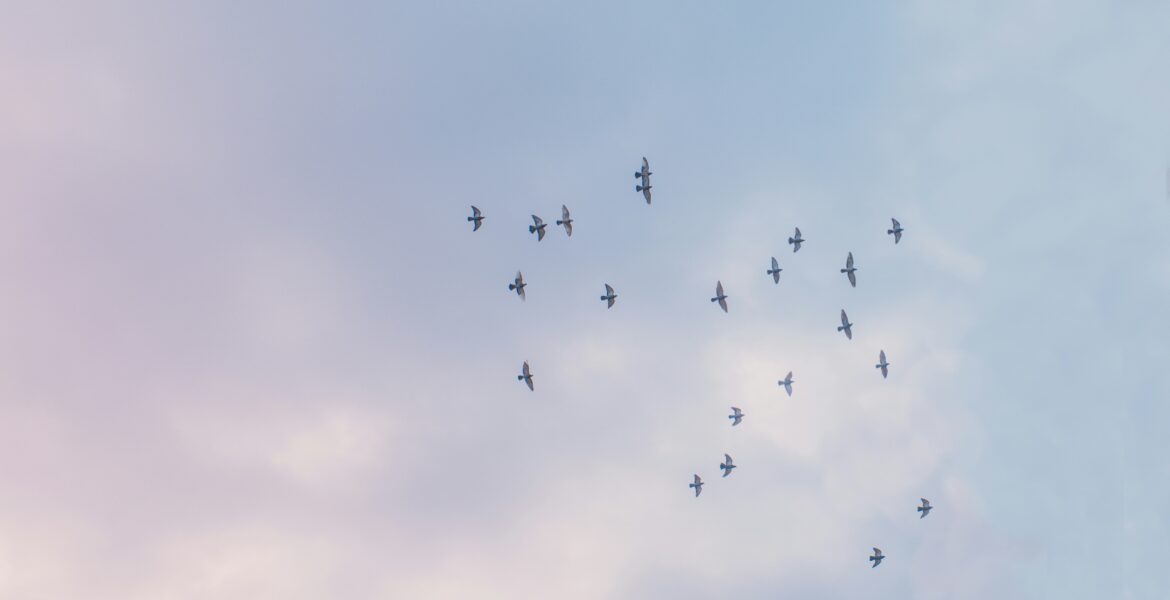
Earlier this month, it was World Migratory Bird Day. Honey Kohan, Head of Communications, BirdLife Europe and Central Asia wrote for EU Political Report.
Somewhere over the Strait of Gibraltar, a tiny bird weighing less than a €1 coin is crossing between continents. It doesn’t recognise borders. It knows only the pull, ancient and cellular – north in spring, south in autumn, a rhythm as old as the tilting of the Earth.
Migratory birds make the world feel, briefly, coherent. A swallow arriving at a barn in April has wintered somewhere in sub-Saharan Africa, navigating by stars, magnetic fields and memory, surviving storms, deserts, and open sea. The osprey fishing in your local lake may have hatched in Scotland, or Finland, or somewhere you have never been and may never go. In their small bodies they carry the whole map.
There is a reason people have always watched them. Their return is celebrated in cultures from Japan to West Africa, their departure has carried centuries of longing in poetry and song. They are proof that the world extends beyond our immediate horizon, and that it is still connected.
But the numbers, when you look at them, are difficult to hold.
Nearly half of the world’s bird species are in decline. According to BirdLife International’s State of the World’s Birds report only 6% have increasing populations. One in eight, some 1,409 species, face extinction. In North America, almost three billion birds have been lost since 1970. In Europe, over 600 million since 1980 – across a landmass 5 times smaller. The skies are, quite literally, emptying.
Their decline is the consequence of choices: what we grow, how we grow it, what we spray on it, and what we permit in the name of efficiency and profit. Farmland birds like lapwings, skylarks, and turtle doves have been hit hardest. Agricultural intensification has stripped the land of insects, weeds, and the fallow corners these birds depended on. We did not set out to silence them. But we have.
In 1979, the European Community, what would become the EU, did something genuinely visionary. It passed the Birds Directive, its first piece of nature legislation, built on a recognition that was radical at the time: migratory birds cross borders, and protecting them requires countries to act together. Multilateralism as an ecological necessity. The directive established protected areas, restricted hunting, and began, slowly, to shift the culture around wild birds.
The results were real. The generalised slaughter of migratory birds along Mediterranean coastlines, once treated as a seasonal tradition, was significantly reduced. The Natura 2000 network of protected habitats allowed flamingo and cormorant populations to recover from the edge of local extinction to the point where seeing them feels ordinary. This is what good legislation looks like: nature given the space to respond.
But the Birds Directive has always had a powerful enemy. The intensive farming lobby, one of the most organised and well-funded political forces in Brussels, has consistently pushed to weaken it, to carve out exemptions, to frame environmental protection as an obstacle to food security. And too often, politicians have listened. The Common Agricultural Policy remains structurally aligned with the very practices driving bird decline. Every reform that might have changed that has been negotiated down, delayed, or diluted.
And now the pressure is intensifying.
Across Europe, a coordinated deregulation drive, dressed in the language of competitiveness and farmers’ rights, is targeting the very foundations of nature protection. Proposals to weaken pesticide restrictions, roll back wetland protections, and open the door to greater agricultural pollution are advancing through national governments and EU institutions alike. The Birds Directive itself, once considered untouchable, is increasingly in the crosshairs. What was hard-won over decades of scientific argument and political negotiation is being framed, cynically, as red tape.
BirdLife International and its national partners have spent decades documenting the damage and advocating for the protections that could halt it. The science is not in dispute. The political will is.
The swallow crossing the Strait of Gibraltar doesn’t know which side of the water has better governance. Ecological collapse is not stopped by barbed wire. The Birds Directive was born from the understanding that nature requires us to work together, across borders, across Europe, across political cycles. That understanding is now under attack. So today, in honour of World Migratory Bird Day, I will stop and look up. In awe of these small, defenceless travellers. And with the uneasy feeling that I don’t know how many more springs will bring them back.