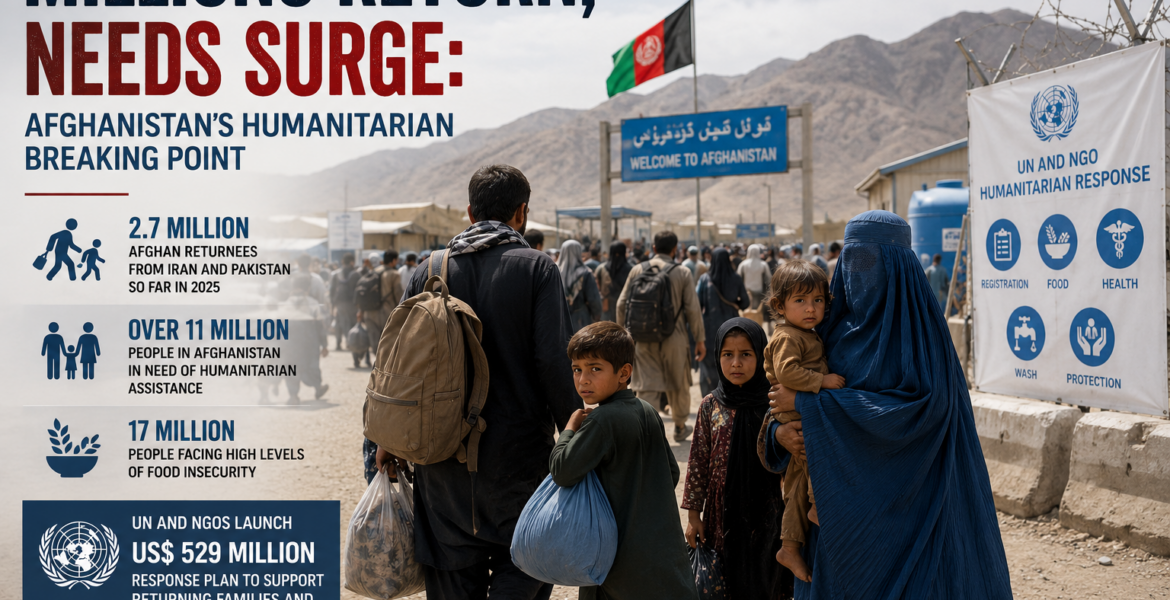
The United Nations’ launch of a US$529 million response plan for the 2.7 million Afghans expected to return from Iran and Pakistan this year marks one of the most significant humanitarian and demographic interventions in Afghanistan since the Taliban’s return to power in 2021. Announced in Kabul, the plan reflects both the scale of the crisis and the political sensitivities surrounding a mass return movement reshaping Afghanistan’s social fabric at an extraordinary pace. Since September 2023, nearly 5.9 million Afghans have crossed back into the country — a population shift amounting to roughly 10 to 12 per cent of Afghanistan’s total population in just over two years. For a country already grappling with economic collapse, restricted civic space, and severe limitations on women’s rights under Taliban rule, the implications are profound.
UN Resident Coordinator and Humanitarian Coordinator a.i. Dr Tajudeen Oyewale captured the gravity of the moment, warning that “this is not a short‑term border event. It is a profound demographic and development challenge that requires a sustained, principled, and fully funded response.” His emphasis on the long arc of reintegration — not just emergency relief — is a pointed reminder to donors that Afghanistan’s crisis cannot be managed through stopgap humanitarianism alone. More than half of those returning are women and children, many of whom have never lived in Afghanistan and have “weak or no ties to their communities of origin.” The political subtext is clear: without investment in livelihoods, housing, water, health, and protection, the risk of secondary displacement and social tension will rise sharply, affecting both returnees and host communities.
The plan’s two‑tier structure reflects this dual reality. At the borders, where the International Organisation for Migration leads the consortium, agencies require US$100.7 million to provide immediate assistance — cash, health services, nutrition support, protection, WASH, and transport. Yet even this figure covers only 40 per cent of the most vulnerable, despite 70 per cent meeting vulnerability criteria. As World Vision International’s Country Director, Thamindri De Silva, put it, “the scale of need is immense, but so is the collective capacity of UN agencies, NGOs, and our partners.” Her warning about funding gaps at the border underscores a broader political challenge: donor fatigue, competing global crises, and the geopolitical discomfort many governments feel about engaging with Afghanistan’s de facto authorities.
Beyond the border, the plan allocates US$428.5 million for reintegration in 35 priority districts. These areas, already strained by drought, economic contraction, and limited public services, now face a population surge that could destabilise local governance structures. The focus on restoring access to education, health, and water services — alongside securing housing and land rights — is not only a humanitarian imperative but a political one. In a context where the Taliban tightly control civic space and restrict women’s participation in public life, the ability of UN agencies and NGOs to deliver gender‑sensitive, protection‑centred programming will be a test of operational neutrality and diplomatic finesse.
For the EU and its Member States, the launch of the 2026 Response Plan lands at a politically delicate moment. European capitals remain deeply concerned about regional instability, migration pressures, and the humanitarian fallout of Afghanistan’s isolation. Yet the EU’s engagement is constrained by its refusal to recognise the Taliban regime and its insistence on human rights benchmarks — particularly for women and girls — as a condition for deeper cooperation. The returnee crisis complicates this calculus. A failure to support reintegration risks further destabilisation, which could in turn drive onward movement and regional insecurity. But increased funding without political leverage risks entrenching a governance environment that systematically excludes half the population.
Diplomats attending the launch in Kabul were acutely aware of this tension. While the event was framed as a humanitarian mobilisation, the political stakes were unmistakable. The UN’s call for full funding is, in effect, a call for the international community to confront the uncomfortable reality that Afghanistan’s crisis is no longer contained at its borders. The mass return of Afghans from Iran and Pakistan — driven by domestic policies in both countries — is reshaping the humanitarian landscape faster than donors have been willing to adapt.
The coming months will test whether the international community can move beyond rhetorical concern to sustained, strategic investment. The UN and its partners have laid out a plan that is technically sound, operationally grounded, and politically aware. What remains uncertain is whether donors will meet the moment. As Dr Oyewale warned, without medium‑term investment, Afghanistan faces a future of “deepening poverty and social tensions” that will reverberate far beyond its borders. The choice now lies with those governments whose decisions — and hesitations — will shape the trajectory of millions of Afghan lives.
Image credit: ChatGPT using UN logo