
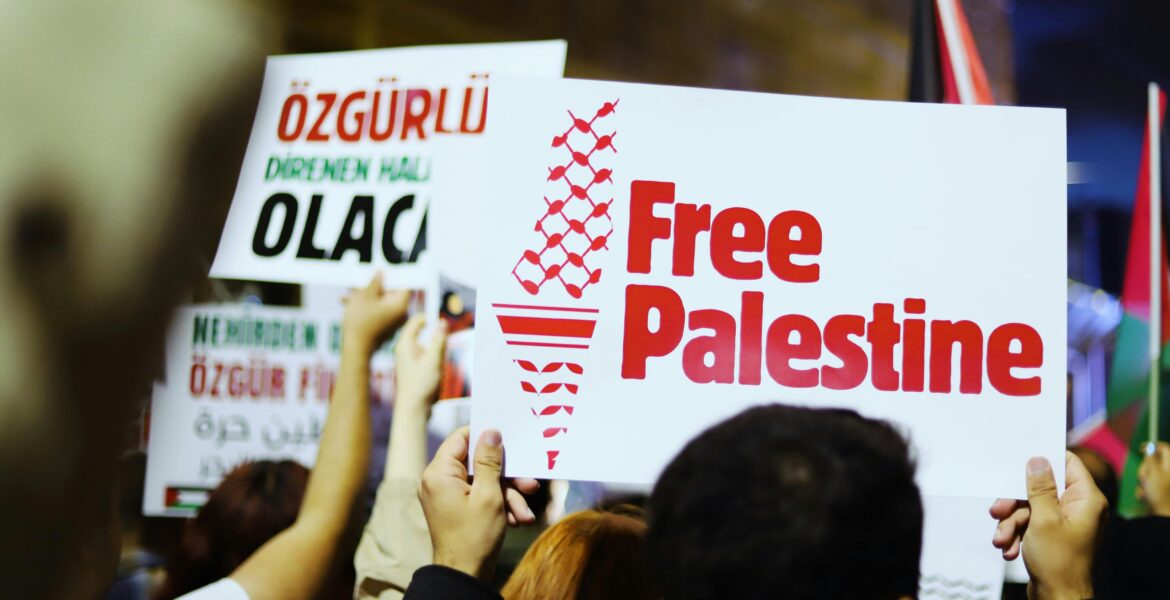
© Photo by Isra Nilgün Özkan on Pexels
The war in Palestine has become a defining test of Europe’s credibility on human rights, as reports of large‑scale civilian suffering collide with an EU response widely criticised as slow, cautious and internally divided.
The conflict in Gaza has produced some of the most severe human rights concerns in recent years, with international organisations documenting catastrophic levels of civilian casualties, mass displacement and the destruction of essential infrastructure. Gaza has endured catastrophic acts of violence and human rights abuses, with entire neighbourhoods levelled and humanitarian access repeatedly obstructed. These conditions have fuelled accusations that the international community, including the European Union, has failed to uphold its stated commitment to human rights and the protection of civilians.
Within the EU, the political response has been marked by hesitation and fragmentation. Critics argue that the Union has struggled to articulate a coherent strategy, constrained by differing national positions and a longstanding reluctance to confront Israel more forcefully over its military conduct. Some European countries have moved to recognise Palestinian statehood, signalling a potential shift in approach, but these steps have been described by some as “too little, too late” in the face of ongoing violence. This perceived caution has led to accusations of complicity, particularly as humanitarian conditions in Gaza continue to deteriorate.
At the institutional level, the EU has attempted to position itself as a supporter of diplomatic efforts to halt the conflict. The High Representative has welcomed the first phase of a Comprehensive Plan to end the Gaza war, calling for an immediate ceasefire, the release of hostages and unimpeded humanitarian access. The EU has also pledged readiness to contribute to Gaza’s stabilisation and reconstruction, including through its existing missions such as EUBAM Rafah and EUPOL COPPS. These commitments reflect the Union’s longstanding role as the largest financial supporter of the Palestinian Authority and a major funder of UNRWA.
Yet these diplomatic and financial efforts have not shielded the EU from criticism. Analysts note that despite its economic weight and its self‑image as a defender of human rights, the EU has often been perceived as a “payer rather than a player,” lacking the political will to leverage its influence to protect civilians or advance a credible peace process. The aftermath of the 7 October attacks and Israel’s subsequent military campaign has intensified this scrutiny, forcing the EU to confront the gap between its humanitarian rhetoric and its geopolitical caution.
For Palestinians, the consequences of this imbalance are stark. Humanitarian agencies warn that without sustained pressure for a ceasefire and guaranteed access for aid, the civilian toll will continue to rise. For Europe, the crisis poses a deeper challenge: whether the Union can reconcile its strategic interests with its foundational commitment to human rights. As the conflict continues, the EU’s response will shape not only conditions on the ground in Gaza but also Europe’s standing as a global actor capable of defending the principles it claims to uphold.
– by Siobhan Dillon, Editor-in-Chief