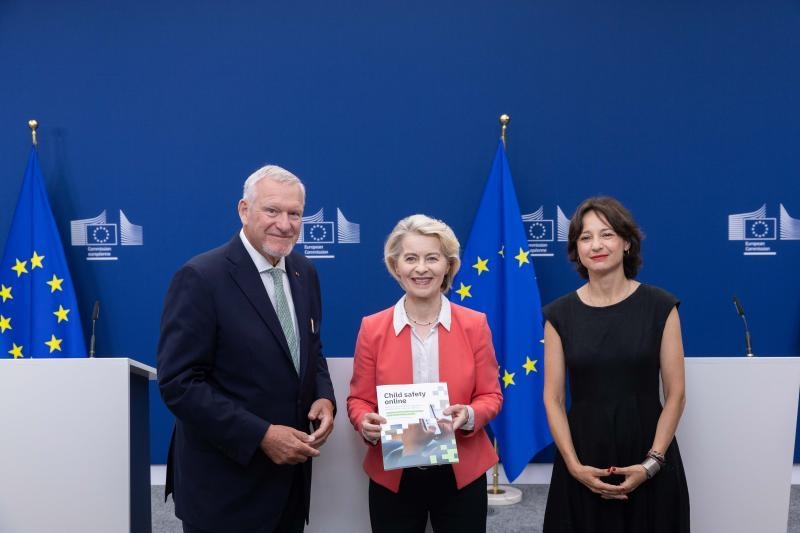
President von der Leyen’s statement alongside the Co‑Chairs of the Special Panel on Child Safety Online marks a decisive moment in Europe’s long‑running struggle to regulate the digital sphere. What could have been a technical update on a commissioned report instead became a political declaration: the era of permissive, unregulated access to children by social media platforms is ending, and Brussels intends to lead the cultural shift required to make that real.
The President’s language was unusually direct. Social media, she said, “is not a toy,” and the status quo, where big tech enjoys unrestricted access to children, is no longer tolerable. The framing is deliberate. For years, the EU’s digital agenda has been built around rights, competition, and market fairness. Today’s message was different: it was about childhood itself and the political responsibility to protect it. By anchoring the argument in evidence from the Special Panel, von der Leyen positioned the Commission not just as a regulator, but as a guardian of a societal norm that has eroded faster than governments have been able to respond.
The political stakes are clear. Europe’s digital legislation, from the Digital Services Act to the upcoming age‑verification tools, has often been criticised as reactive. Von der Leyen’s statement flips that narrative. She argues that platforms, as the architects of the systems children use, must now prove their products do no harm. The comparison with car manufacturers and seatbelts was not accidental. It was a rhetorical attempt to shift responsibility away from parents and onto companies, reinforcing the EU’s long‑standing principle that safety‑by‑design is not optional. The recent enforcement actions against TikTok and Meta serve as proof points that the Commission is prepared to act and that this agenda is not merely aspirational.
Her call for a “social media start date” is where the politics sharpen. Setting a legal age for access to social media would be one of the most significant regulatory interventions in Europeans’ digital lives since GDPR. It would also require Member States to confront uncomfortable questions about autonomy, parental responsibility, and the limits of state intervention. Von der Leyen acknowledged that change will not be foolproof, nor immediate, but she framed it as a cultural shift comparable to seatbelt laws or drink‑driving bans — measures that once seemed intrusive but are now unquestioned pillars of public safety.
The timing of the report is equally strategic. With several Member States debating national approaches to child safety online, and partners like Australia moving ahead with their own restrictions, the Commission sees a window to shape a coherent European response before fragmentation sets in. By promising a legislative proposal after the summer, von der Leyen signals that this file will be a priority in the coming political season and that she intends to anchor the debate in evidence rather than ideology.
For Brussels watchers, the message is unmistakable. The Commission is preparing to redefine the relationship between children and the digital world, and it expects industry, Member States, and parents to adapt. Europe is drawing a line — not against technology, but against a system that has treated childhood as an afterthought. The political question now is whether the Union can turn this moment of clarity into lasting change.
Image credit: European Commission