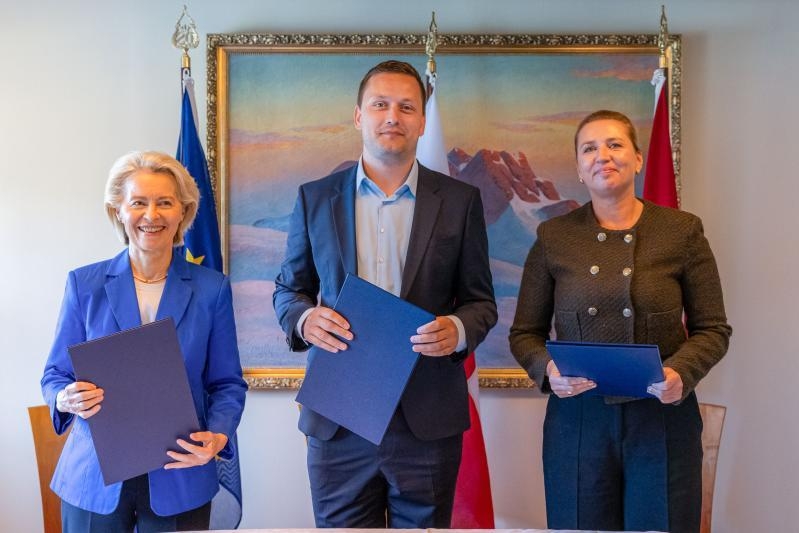
The European Union has moved decisively to strengthen its presence in the Arctic, unveiling a €200 million Global Gateway Partnership Package during Commission President Ursula von der Leyen’s visit to Nuuk. Framed as both a strategic investment and a political signal, the package marks one of the EU’s most substantial commitments to Greenland to date, reinforcing a partnership that Brussels increasingly views as central to Europe’s geopolitical resilience.
“Greenland can count on the EU,” von der Leyen declared, emphasising that the new funding represents “the real results of our close cooperation… because Greenland is a strategic ally and a trusted friend.” Her choice of language was deliberate. As global competition intensifies over critical raw materials, secure connectivity and Arctic routes, the EU is seeking to anchor its relationship with Greenland in a way that is both economically meaningful and politically durable.
The announcement coincided with the signing of a renewed Joint Declaration between the EU, Greenland and Denmark, expanding cooperation across education, infrastructure, clean energy, digital connectivity, sustainable raw materials, fisheries, climate action and security. The breadth of the agenda reflects the EU’s evolving understanding of Greenland not merely as an Overseas Country and Territory, but as a strategic partner whose resources, location and political alignment matter for Europe’s long‑term stability.
Commissioner for International Partnerships Jozef Síkela underscored this dual purpose, noting that the partnership is “about creating opportunities that improve people’s everyday lives… At the same time, by investing together through Global Gateway, we are strengthening Europe’s resilience, building trusted partnerships that benefit us all.” His remarks capture the Commission’s wider strategy: development support that doubles as geopolitical positioning.
The investment package blends hard infrastructure and social development. Satellite connectivity projects with Tusass aim to close digital gaps across remote settlements; feasibility work on data centres hints at future Arctic digital hubs. Support for sustainable mining, including the Amitsoq graphite project designated as an EU Strategic Project, signals Europe’s intent to secure critical raw materials through trusted supply chains. Energy investments, from hybrid renewable systems in remote towns to potential expansion of the Buksefjord hydropower plant, align with both Greenland’s decarbonisation goals and Europe’s search for stable green energy partnerships.
Politically, the move strengthens the EU’s Arctic footprint at a moment when global interest in the region is accelerating. It also deepens ties with Denmark, whose stewardship of Greenland remains a sensitive but stabilising factor in Arctic governance. For Greenland, the package offers tangible economic diversification and a clearer pathway into European value chains.
For Brussels, the message is unmistakable: Europe intends to be a long‑term actor in the Arctic, and it is willing to invest heavily to secure that role.
Image credit: European Commission