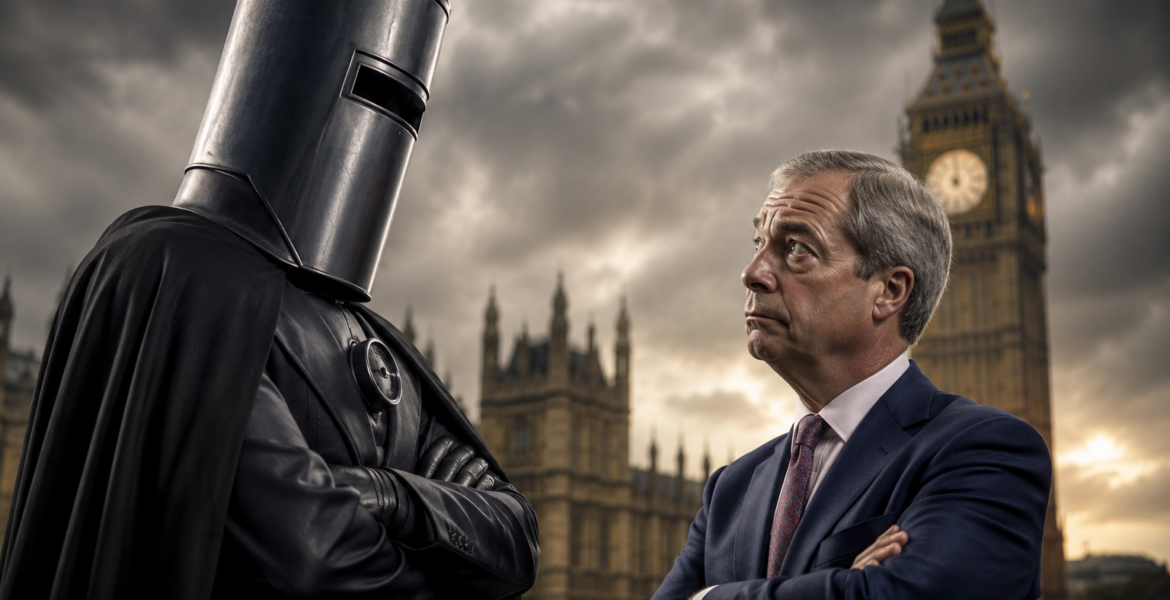
Nigel Farage’s latest political manoeuvre has turned the UK’s Clacton by‑election into a spectacle that feels closer to performance art than conventional campaigning. His abrupt resignation and immediate decision to re‑contest the seat, presented as a crusade against what he calls an entrenched establishment, has left Britain’s main parties refusing to participate, accusing him of engineering a distraction from questions surrounding undeclared financial gifts. In their absence, the race has taken on an unexpected character, shaped not by traditional political rivalry but by the arrival of Count Binface, the satirical space‑faring persona who has become a recurring feature of British democratic theatre.
Farage has long relied on a narrative of insurgency, positioning himself as the outsider who unsettles institutions. Yet this time, the framing appears to be slipping away from him. The circumstances of the by‑election, triggered amid scrutiny of multimillion‑pound donations from wealthy supporters, have raised concerns across the political spectrum. With Labour, the Conservatives and Liberal Democrats declining to field candidates, Farage’s attempt to recast the contest as a referendum on his own conduct has instead opened the door to a challenger who thrives precisely in moments when politics becomes self‑parody.
Count Binface, the creation of comedian Jon Harvey, has built a reputation for using humour to expose the contradictions of British political life. His manifesto, deliberately absurd yet pointed, has become a vehicle for highlighting the excesses and eccentricities of the political class. He has stood against prime ministers, mayors and party leaders, always with the same bin‑shaped helmet and a commitment to puncturing the seriousness with which British politics often presents itself. His decision to enter the Clacton race followed Farage’s resignation, which he framed as an act of political self‑destruction.
What makes this contest notable is not simply the presence of a parody candidate, but the seriousness with which some in the public have begun to take the possibility of an upset. Bookmakers have shortened the odds on Binface, reflecting both public frustration and the vacuum created by the absence of mainstream contenders. While analysts caution that Clacton remains one of Farage’s strongest constituencies, the symbolism of a two‑man race, one a populist veteran, the other a comedic foil, speaks to a deeper disillusionment with traditional politics.
Farage retains significant support among local voters, particularly on themes of immigration and anti‑establishment sentiment. Yet the campaign’s tone, from seaside photo‑ops to Binface’s intergalactic rhetoric, underscores how political performance increasingly shapes public perception. The by‑election has become a stage on which British political culture is being contested, satirised and exposed.
Whether Farage’s gamble ultimately reinforces his outsider narrative or backfires by elevating his satirical opponent, the Clacton contest reveals a political landscape where frustration, humour and protest now intermingle freely. Count Binface may not be expected to win, but his presence ensures that Farage’s attempt to control the narrative will face an unexpected and unavoidable challenge.
This is the same Farage whose voting record in the European Parliament was defined by low participation, high opposition, and a clear preference for political theatre over legislative engagement. His attendance rate hovered around 30–31%, compared with a parliamentary average of roughly 84%, placing him among the least present MEPs of his era. Instead, as your Editor can attest, he was frequently seen drinking in the Members’ bar at all hours. Now that would make it difficult to vote…
Image: ChatGPT